AI Fear Is Familiar. We’ve Been Here Before.
the organizations that survived Y2K weren’t the ones that panicked — they were the ones that documented, tested, and owned responsibility for their systems.
Bob McTaggart edited with AI
2/5/20263 min read

AI Fear Is Familiar. We’ve Been Here Before.
I was in uniform when the world braced for Y2K.
Banks stockpiled cash.
Consultants made fortunes.
Executives were told computers might simply… stop.
Some risks were real. Most systems did need remediation.
But the public narrative was engineered to sound like civilization was about to blink out at midnight.
That didn’t happen.
What did happen was quieter and more instructive:
the organizations that survived Y2K weren’t the ones that panicked — they were the ones that documented, tested, and owned responsibility for their systems.
AI fear today feels very similar.
Not because AI is harmless — it isn’t.
But because the loudest voices are again profiting from confusion while genuine risks get buried under spectacle.
How AI Fear Is Manufactured
Modern AI coverage lives in a false binary:
miracle or monster.
One week, AI will “cure disease and unlock abundance.”
The next, it will “wipe out jobs, democracy, and humanity itself.”
That oscillation isn’t accidental. It keeps people emotional, reactive, and disengaged from practical governance.
Language plays a role.
AI is described as thinking, deciding, wanting — when in reality it is executing statistical pattern matching designed by humans, deployed by humans, and governed (or not) by humans.
Anthropomorphism inflates capability and dissolves accountability.
And when accountability dissolves, fear rushes in to fill the gap.
Follow the Incentives, Not the Headlines
When fear spikes, ask a simple question: who benefits?
• Large incumbents benefit when regulation becomes expensive and complex
• Lobbyists benefit when urgency overrides scrutiny
• Media platforms benefit when engagement is driven by emotion, not nuance
• Some researchers benefit when funding follows existential narratives
This is not conspiracy. It’s incentive structure.
We saw the same playbook in the late 1990s with open-source software:
Fear, Uncertainty, and Doubt used to slow competitors while incumbents positioned themselves as the “safe” option.
AI panic serves the same function.
The Existential Risk Debate Misses the Point
The problem with doomsday AI narratives isn’t that alignment research is illegitimate — it’s that existential framing crowds out present-day accountability.
While people argue about hypothetical superintelligence, real harm is already happening:
• Biased systems influencing sentencing, hiring, and healthcare
• Deepfake fraud causing real financial and political damage
• Automation quietly removing entry-level roles without replacement pathways
• Hallucinating systems being trusted beyond their reliability
These are not future risks.
They are operational failures happening now.
And unlike science-fiction threats, these failures have owners.
What the Evidence Actually Supports
Bias Is Real and Measurable
Systems trained on biased data reproduce bias at scale. This is not philosophical — it is documented, repeatable, and already litigated.
Deepfakes Are a Trust Weapon
Fraud, market manipulation, election interference — all already observed. The damage is social before it is technical.
Job Displacement Is Selective, Not Apocalyptic
Tasks are disappearing. Responsibility is concentrating. Organizations that automate without redesigning human oversight are creating brittle systems and legal exposure.
Reliability Is Still a Problem
Hallucination is not a UX quirk. It is a structural limitation. Over-reliance without verification is a governance failure, not a model failure.
Alignment Is Real — But Not the Way It’s Sold
Serious researchers largely agree on the types of risk:
• Goal mis-specification
• Misgeneralization
• Instrumental shortcuts
• Poor controllability
What they do not agree on is the timeline.
Most do not believe scaling current systems alone leads to imminent general intelligence.
That matters, because urgency shapes policy — and fear-based urgency tends to favor centralized control and incumbent advantage.
Why This Feels Like Y2K All Over Again
Y2K wasn’t solved by panic.
It was solved by inventory, documentation, testing, and accountability.
The same applies to AI.
The real dividing line isn’t believers vs skeptics.
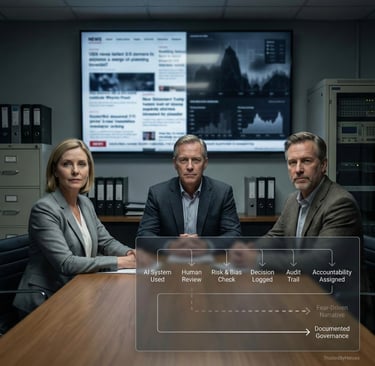
It’s organizations that can explain:
• What AI systems they use
• What those systems are allowed to do
• Where humans intervene
• How decisions are logged and reviewed
—and those that cannot.
When fear fades, audits remain.
A Simple Test for Decision-Makers
When evaluating any AI claim, ask:
Who benefits if I believe this?
Is the harm documented or hypothetical?
Is responsibility clearly assigned?
Does the solution reduce risk — or consolidate power?
Can this system be explained after something goes wrong?
If the answers are emotional, vague, or defensive — you’re looking at hype.
Final 2 cents,
AI is neither savior nor villain.
It is infrastructure.
And like every major infrastructure shift I’ve lived through — military, financial, digital — the danger isn’t the technology.
It’s abandoning responsibility because fear made accountability inconvenient.
Y2K taught us that discipline beats panic.
AI will teach the same lesson — whether we choose to learn it early or in court.
—
Bob McTaggart
Military Veteran | AI Governance & Risk
Edited with AI
Informational commentary only. Not legal or regulatory advice.
Supporting
Getting Veterans and First Responders back on mission.!
Veteran-inspired AI Governance & Trust Infrastructure
Trusted by Heroes and Mounted Rifles Management
Leadership and peer support are taught through RedFridayTalks.Help
The same governance protections are available to everyone.
© 2026. All rights reserved.