Good Faith Compliance: Immediate AI Governance and ABA Guidance alignment
The Risk Is Not AI — It Is the Lack of Evidence
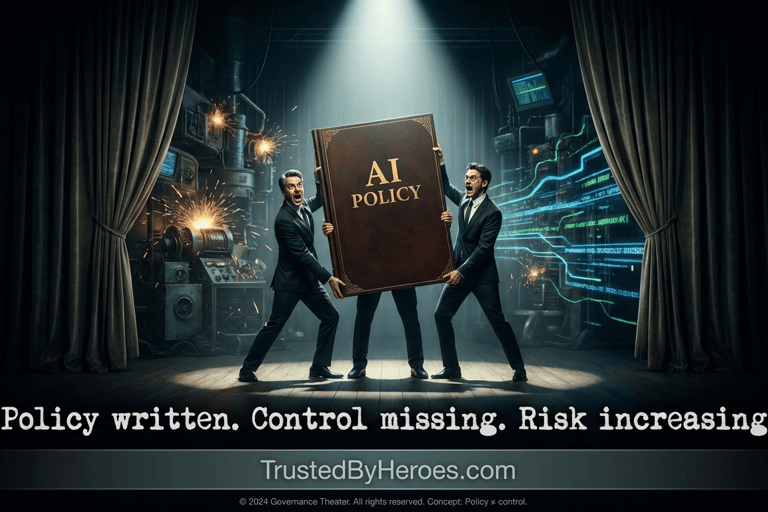
AI enforcement does not require perfection.
It requires proof.
Proof that your organization made a reasonable effort.
Proof that leadership gave clear direction.
Proof that employees received training.
Proof that AI use was not ignored, unmanaged, or left to individual judgment.
Most organizations will not get into trouble simply because they used AI. They will get into trouble because they cannot show:
who authorized AI use
what rules applied
what training was provided
what risks were considered
what evidence exists to prove good-faith governance
That is the gap Good Faith Compliance is built to close first.
Audit Anchor AI and Good Faith Compliance
Audit Anchor AI is the complete suite of AI governance, evidence, oversight, monitoring, and verification services.
It is designed to help organizations move from informal or scattered AI use toward a more defensible, documented, and accountable governance position.
Within that suite, Good Faith Compliance is the frontline system.
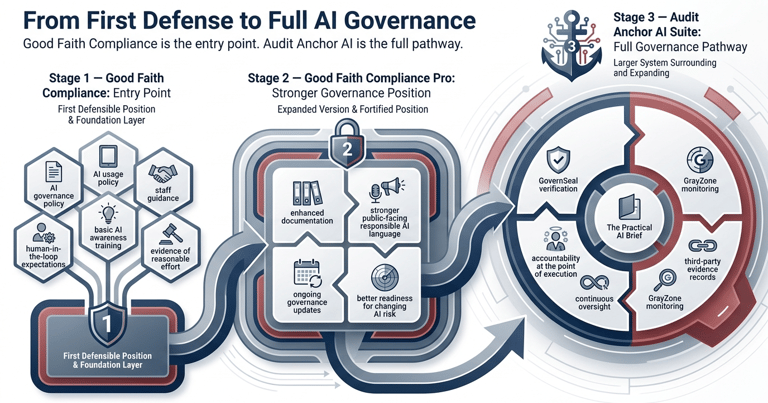
Good Faith Compliance is the practical first step any organization can take to establish a basic AI governance position. It provides the essential starting structure:
Trust Pass training and certification
AI awareness policy
AI governance policy
AI usage rules
staff acknowledgment
human-in-the-loop expectations
documented evidence of reasonable effort
In simple terms:
Good Faith Compliance gets the organization started.
Good Faith Compliance Pro keeps the organization informed, monitored, and supported.
Audit Anchor AI is the complete system that helps the organization mature, prove, and maintain responsible AI governance over time.
What Good Faith Compliance Provides
Good Faith Compliance helps an organization establish its first defensible AI governance position.
It does not claim the organization is fully compliant.
It shows that the organization has taken structured, documented, good-faith steps to govern AI use before problems arise.
What Good Faith Compliance Includes
Good Faith Compliance includes:
company AI governance policy
company AI usage policy
staff AI guidance
basic AI awareness training
human-in-the-loop expectations
acknowledgment records
AI compliance evidence documentation
proof of good-faith effort
This gives the organization a practical starting point that can be shown to regulators, insurers, courts, clients, employers, boards, or public stakeholders when questions are asked.
The purpose is simple:
Create evidence before there is a problem.
From Good Faith Compliance to Good Faith Compliance Pro
Good Faith Compliance gives the organization its first defensible governance position.
Good Faith Compliance Pro builds on that starting point and turns it into an ongoing governance ecosystem.
Good Faith Compliance Pro may include:
everything in Good Faith Compliance
GovernSeal verification
GrayZone monitoring
The Practical AI Brief
ongoing governance updates
AI tools and legislation tracking
governance landscape updates
DHITL training
McTaggart’s Insights
stronger evidence preservation
Good Faith Compliance Pro helps the organization stay current, documented, and supported as AI risks, tools, and rules continue to change.
From Good Faith Compliance Pro to Audit Anchor AI
From there, Audit Anchor AI can expand the organization’s governance position through:
enhanced governance documentation
deeper verification
background cryptographic ledgering
immutable records
advanced oversight systems
accountability at the point of execution
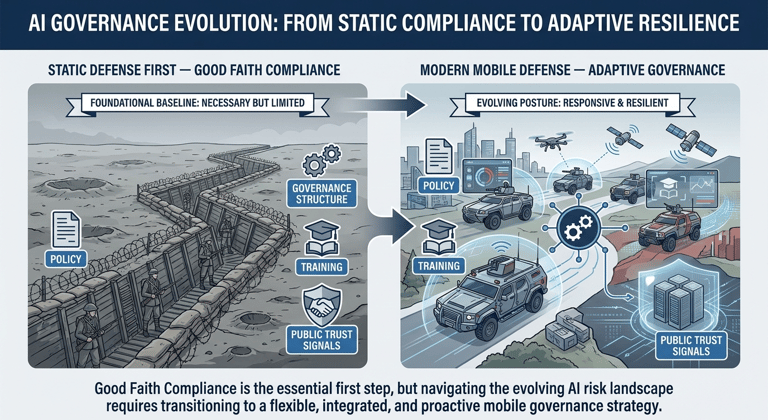
AI governance cannot remain static forever.
Good Faith Compliance is the first step. Good Faith Compliance Pro is the ongoing support layer. Audit Anchor AI is the full-service pathway for organizations that require deeper proof, control, and accountability.
AI law, regulation, professional guidance, insurance expectations, and public trust standards are still developing. That uncertainty does not remove responsibility. It increases the need for documented governance.
Good Faith Compliance is designed to establish that evidence early.
The broader Audit Anchor AI suite is designed to help maintain, verify, and strengthen that evidence as the AI environment changes.
Company AI policies are created, versioned, timestamped, and logged. Employee AI governance training is delivered, acknowledged, and recorded. Staff are moved away from unmanaged AI use and toward policy-aligned, governed behavior.
Critically, the goal is to create credible evidence rather than relying only on internal self-certification.
That gives the organization a stronger, cleaner, more defensible record.
Legal Basis
Plain-Language Interpretation
Across administrative, regulatory, insurance, employment, and professional responsibility environments, documented policies, training, supervision, and good-faith efforts are commonly treated as important mitigating factors.
This is especially true when rules are new, evolving, fragmented, or unevenly applied.
In plain language:
If your organization is challenged, you want to be able to show that you acted early, trained people, created rules, documented effort, and maintained proof.
That does not guarantee immunity.
But it is far stronger than silence, guesswork, or a policy created after something goes wrong.
This material is provided for governance education and business-readiness purposes only. It is not legal advice.
Why You Must Act Now
Habits formed before enforcement determine survivability later.
Waiting creates silent risk.
The danger is not always the major AI project approved by leadership. Often, the real exposure comes from everyday staff use: documents, emails, client data, research, summaries, hiring, customer service, marketing, and decision support.
By the time a regulator, insurer, client, employee, or court asks questions, it is too late to create a credible record of earlier intent.
The record must exist before the problem.
That is why the first step matters.
What Good Faith Compliance Is Not
Good Faith Compliance is not:
legal advice
immunity
a guarantee against liability
a complete AI compliance solution
a replacement for legal counsel
a substitute for industry-specific regulatory advice
Good Faith Compliance is the entry point into Audit Anchor AI.
It is a defensible first position.
It helps establish proof of intent, education, awareness, governance structure, and reasonable effort.
That is often where responsible AI governance begins.
What Comes Next
Good Faith Compliance establishes the first layer.
From there, organizations can move into the broader Audit Anchor AI suite, including:
Good Faith Compliance Pro
Distributed Human in the Loop
ongoing AI oversight
updated governance records
continuous monitoring
GovernSeal verification
GrayZone monitoring
The Practical AI Brief
advanced Audit Anchor evidence systems
stronger human oversight at the point of execution
AI governance cannot remain static forever.
But a static first defense is still better than no defense at all.
Start with evidence.
Start with training.
Start with policy.
Start with Good Faith Compliance.
Then build into Audit Anchor AI as your governance needs mature.
Get Started
To establish your first defensible AI governance position, contact:
Supporting
Getting Veterans and First Responders back on mission.!
Veteran-inspired AI Governance & Trust Infrastructure
Trusted by Heroes and Mounted Rifles Management
Leadership and peer support are taught through RedFridayTalks.Help
The same governance protections are available to everyone.
© 2026. All rights reserved.