Veterans in the Algorithmic Age (2026): Why I’m Paying Attention—and Why I’m Worried
I break down how artificial intelligence is already reshaping the veteran experience in Canada and the United States as we head into 2026, based on what I’ve seen while building real systems—not hype. I explain where AI is touching benefits, mental health, smart homes, employment, and small business, and why the rise of algorithmic bureaucracy should concern veterans and veteran-owned businesses. I also explain why even Salesforce was forced to slow down, and why human accountability, transparency, and guardrails matter now.
Bob mcTaggart - editted with AI
12/30/20254 min read
Veterans in the Algorithmic Age (2026): Why I’m Paying Attention—and Why I’m Worried
I’m not an oracle.
I’m not predicting the future.
I’m reporting what I’ve learned while building systems designed to generate revenue so we can deploy real support—at no charge—to qualified veterans and help veteran-owned small businesses grow in a world that is changing faster than policy, culture, or comfort levels.
2026 isn’t “someday.”
It’s a line-crossing year.
Artificial intelligence stops being a tool some people use and becomes the invisible operating layer inside healthcare, benefits, hiring, insurance, banking, and small business platforms.
For veterans, that matters more than for most.
Veterans live inside systems.
Veterans depend on systems.
Veterans are often processed by systems before a human ever reads the file.
This isn’t political.
It’s structural.
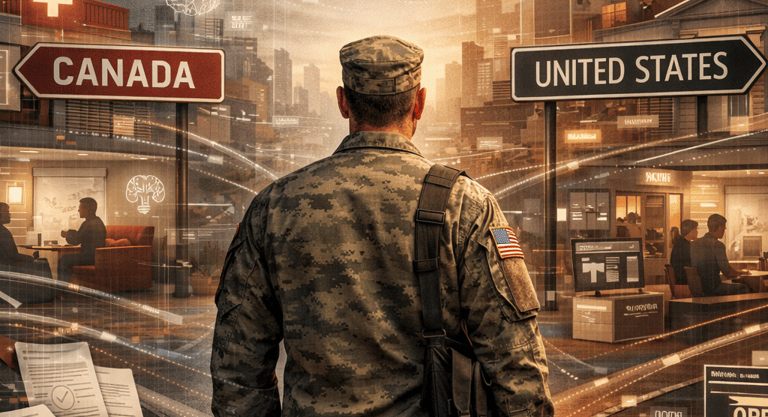
Two Countries, Two Approaches, Same Collision Course
Canada: Guardrails First, Friction Included
Canada’s posture toward AI in veteran services can be summarized simply:
Slow down. Document it. Prove it. Then deploy it.
Veterans Affairs Canada operates in an environment that requires algorithmic impact assessments, privacy reviews, and formal accountability before AI systems are allowed to affect rights or benefits.
On paper, this protects veterans.
In practice, it creates tension.
Canada is expanding:
smart-home supports
assistive technologies
digital tools meant to keep veterans in their homes longer
But every smart device collects data.
And every dataset raises the same question:
Who controls it—and to what end?
Canada’s risk isn’t reckless automation.
It’s slow relief inside complex systems where privacy is respected but frustration builds.
The United States: Speed First, Accountability Catching Up
The U.S. posture is different:
Scale now. Optimize later.
AI is already embedded in:
suicide prevention systems
claims intake and triage
benefits processing
hiring and workforce screening
insurance coordination
Predictive systems now flag veterans as high-risk before they ask for help.
That saves lives.
It also changes the relationship.
Veterans no longer decide when they disclose distress—the system infers it.
The American risk isn’t bad intent.
It’s the rise of algorithmic bureaucracy:
decisions made quickly
explanations delayed or missing
trust quietly eroding
The Trends Veterans Will Feel in 2026
These aren’t theories.
They’re already live.
1. From “Ask” to “Know”
Systems infer risk, instability, or disengagement without conversation.
Helpful—until it feels like surveillance.
2. AI Becomes the First Gatekeeper
AI doesn’t make the final call—but it decides what gets seen.
Veterans encounter AI first in benefits, employment, credit, insurance, and identity systems.
3. Synthetic Companions Become Normal
AI companions now address loneliness and isolation.
Some veterans open up to machines more than people.
Relief is real.
So is the risk of dependency.
4. Homes Become Care Infrastructure
Smart homes restore independence.
They also turn private space into monitored space.
5. Military Experience Finally Translates—If Used Correctly
AI can translate service into civilian value better than any resume class ever did.
Used right, it creates leverage.
Used wrong, it creates exposure.
6. Governance Becomes the New Literacy
The advantage is no longer “being good at AI.”
The advantage is knowing:
where AI is allowed
where it must stop
where humans must approve
how responsibility is documented
A Warning from Inside the System: Salesforce
This is where I started to slow down.
Salesforce is not a startup.
It’s infrastructure.
Banks, insurers, hospitals, governments, and defense contractors run on Salesforce.
When Salesforce moves, the ecosystem follows.
Salesforce pushed hard into autonomous AI agents—systems capable of acting, triggering workflows, and interacting with customers with minimal human involvement.
Technically, it worked.
Operationally, something broke.
Customers began asking:
Who approved this?
Why did the system do that?
Was this a human or an AI agent?
Salesforce leadership acknowledged the issue and changed course.
Not because the AI failed.
Because control and accountability were slipping behind capability.
They re-centered their strategy on:
human-in-the-loop controls
explicit approvals
clear attribution
auditability
If a company with Salesforce’s resources can nearly outrun its own governance, smaller organizations absolutely will—often without realizing it.
Why I’m Sharing This
Because I’ve spent the year building systems for this exact environment.
Not hype systems.
Not automation-for-automation’s-sake.
Systems that:
generate revenue responsibly
reduce legal and operational risk
document human oversight
and can be deployed at no charge to qualified veterans
Veterans don’t need more tools.
They need guardrails inside the tools they’re being pushed to use.
Why I Am Worried
I’m not worried because AI exists.
I’m worried because governance is lagging behind adoption, and veterans are always among the first groups routed through large, impersonal systems.
I’m worried because:
decisions are being shaped before humans look
explanations are becoming optional
accountability is getting harder to point to
and “the software did it” is becoming an acceptable answer
I’m worried because Salesforce—one of the most disciplined enterprise platforms in the world—recognized they were moving faster than their ability to control what they built.
If that can happen there, it will happen everywhere.
Most veteran-owned small businesses don’t have:
compliance teams
legal buffers
ethics board
room to absorb one automated mistake
Veterans understand responsibility.
They understand chains of command.
They understand that someone always owns the outcome.
What worries me is a future where that principle gets blurred by algorithms.
AI is not the enemy.
Ungoverned AI is.
That’s why I’m building guardrails.
That’s why I’m sharing this.
And that’s why I’m not staying quiet.
Humans must remain accountable.
Decisions must remain explainable.
Veterans must remain visible.
That’s not fear.
That’s responsibility.
Wriiten by Bob McTaggart edited with AI
Supporting
Getting Veterans and First Responders back on mission.!
Veteran-inspired AI Governance & Trust Infrastructure
Trusted by Heroes and Mounted Rifles Management
Leadership and peer support are taught through RedFridayTalks.Help
The same governance protections are available to everyone.
© 2026. All rights reserved.