Data is the New Ammunition: A View from the Armor Hull on AI and the Future of the Tank
Bob McTaggart edited with AI
6/29/20263 min read
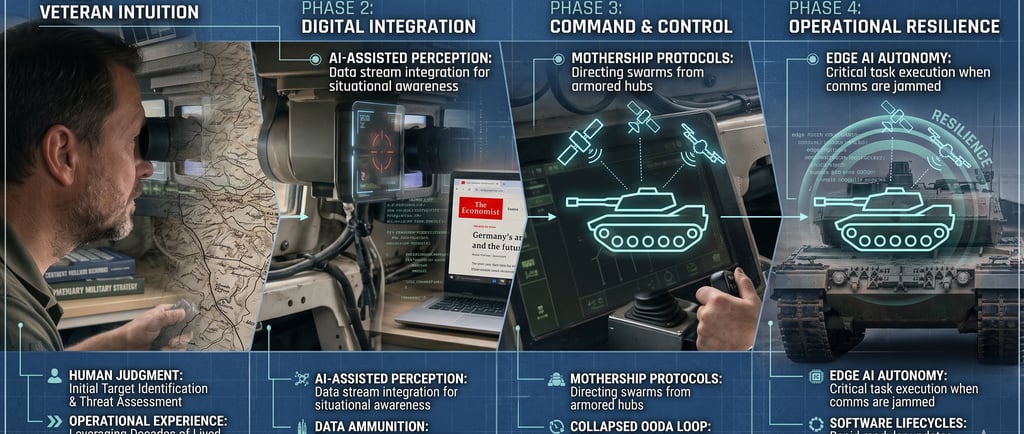
Data is the New Ammunition: A View from the Armor Hull on AI and the Future of the Tank
I was recently reading an interview in The Economist featuring Lieutenant General Christian Freuding, Chief of the German Army’s Planning and Command Staff.
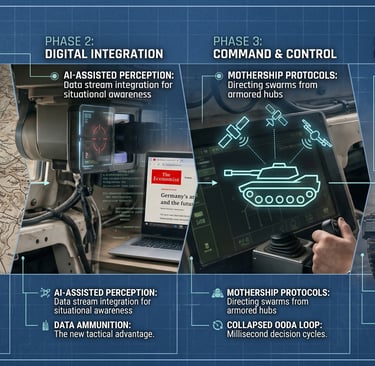
When asked if the multi-million dollar main battle tank is obsolete in an era of $500 commercial drones, the General didn't hesitate. He stated flatly that the tank is not dead, but its role has changed. It is evolving into a "mothership" for unmanned systems—a heavy, armored command hub directing its own ground robots and aerial drones.
More importantly, he pointed out that modern armies no longer suffer from a lack of information; they are drowning in it. His core takeaway for the modern battlefield is simple: "Data has truly become the new ammunition."
As someone who spent years operating inside the cramped, noisy hulls of Leopard tanks and M113 armored personnel carriers, this interview hit home. When you are looking through a periscope, survival depends on how fast you can process a threat and react.
Digging deeper into how modern military minds are approaching artificial intelligence, it is clear that this isn't a conversation about tech trends. It is about a structural shift in how complex systems survive under immense pressure. Whether you are managing mechanized land forces or directing a corporate enterprise, the operational realities of AI remain the same.
1. The Collapse of the OODA Loop
In tactical doctrine, success is dictated by the OODA Loop (Observe, Orient, Decide, Act). In the past, the challenge was finding the enemy. Today, with digital sensors, thermal optics, and signals intelligence everywhere, the challenge is filtering out the noise. When thousands of data points hit a command post simultaneously, the human brain becomes the bottleneck.
The military is implementing AI because automated data processing is the only mechanism fast enough to compress the time between target detection and defensive response down to
milliseconds.
The Reality for Leaders: If your teams are still manually sorting through massive data repositories to make strategic decisions, your loop is too slow. AI’s utility is not in replacing the decision, but in stripping away the administrative noise so the decisive action can happen immediately.
2. Software Lifecycles vs. Heavy Iron
During my time in service, military hardware was built to last for decades with periodic mechanical overhauls. A tank hull or an infantry carrier is a long-term investment. But AI models and software architectures iterate every few months.
General Freuding’s concept of a "mothership" tank means that a physical asset is now only as viable as its underlying digital backbone. If upgrading a vehicle's ability to coordinate autonomous drones requires a five-year procurement cycle, that asset is obsolete before it leaves the depot.
The Reality for Leaders: Rigid, monolithic infrastructure is a liability. If your primary operations cannot integrate modular, platform-independent tools without a massive corporate IT overhaul, you are relying on legacy hardware in a software-driven market.
3. Edge Autonomy and Operational Resilience
On the modern battlefield, heavy electronic warfare (EW) and localized jamming routinely sever the data links between remote pilots and their drones. When the network drops, standard remote-controlled systems fail. To counter this, the military is prioritizing Edge AI—processing data locally on low-power chips embedded directly within the unit. If the link to command is cut, the unit must have enough onboard intelligence to complete the task autonomously.
The Reality for Leaders: True resilience means avoiding absolute dependence on external pipelines. In enterprise operations, "jamming" occurs when critical external APIs change, vendor platforms lock you out, or networks fail. Your automated workflows must have enough localized logic to maintain integrity when connection to the main hub is disrupted.
The Guardrail: "Human-on-the-Loop"
General Freuding strongly emphasized the ethical necessity of keeping a human in the loop for lethal decisions. However, when facing algorithmic speed, human reaction times are insufficient for micro-level adjustments.
We are moving away from "human-in-the-loop" (where a human executes every single step) toward a "human-on-the-loop" framework. In this model, the human acts as an overseer who monitors the automated system, manages the parameters, and retains ultimate veto power, while letting the machine execute the high-speed processing.
The future of capability—both on the ground and in the market—no longer belongs to the side with the heaviest iron or the most raw data. It belongs to the organization that can build a mature, secure digital backbone to convert that data into immediate, actionable execution.
How is your organization adjusting to the shift from data scarcity to data deluge? Let's discuss in the comments.
#DefenseTech #AI #Strategy #Operations #Leadership #Technology
Supporting
Getting Veterans and First Responders back on mission.!
Veteran-inspired AI Governance & Trust Infrastructure
Trusted by Heroes and Mounted Rifles Management
Leadership and peer support are taught through RedFridayTalks.Help
The same governance protections are available to everyone.
© 2026. All rights reserved.