Deleting Your ChatGPT History is Now a Career-Altering Legal Liability
This article analyzes a landmark court decision from late May 2026 to show why manual, unmonitored AI use is an existential threat to enterprise data preservation—and positions your platform as the required automated fallback.
Bob McTaggart
6/10/20263 min read

Deleting Your ChatGPT History is Now a Career-Altering Legal Liability
For many corporate professionals and legal teams, clearing a browser cache or deleting a personal app account feels like standard digital hygiene. If an experimental tool glitches or produces bad data, the immediate instinct is often to wipe the slate clean and start over.
But a federal court has just turned that simple action into an existential threat to your career and your business.
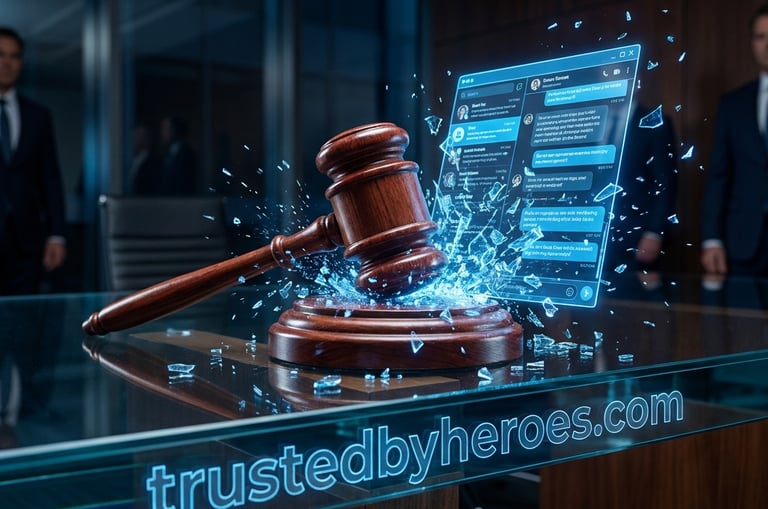
In the precedent-setting case Miller v. Regions Bank, Alabama District Judge Harold D. Mooty III handed down catastrophic, "career-altering" sanctions against an attorney who intentionally deleted his ChatGPT account. The penalty was severe: a public reprimand, immediate disqualification from the case, referral to licensing authorities, and a mandatory six-month suspension from practicing law.
The judge’s reasoning sends a chilling message to the entire corporate world: AI chat histories are formal operational evidence, and deleting them is bad-faith spoliation of data.
The Cover-Up is Always Worse Than the Mistake
The crisis in Miller v. Regions Bank began when an attorney submitted a legal brief containing four fabricated quotations generated by AI. When the court discovered the fake citations and ordered the attorney to produce screenshots of his ChatGPT account history for an in camera review, the attorney panicked.
Three days after receiving the direct court preservation order, the attorney deleted his paid ChatGPT account. He even went so far as to request a prorated refund to ensure his immediate access—and the underlying history—would terminate instantly rather than lingering until the end of the billing cycle.
Judge Mooty’s assessment was unsparing:
“Lawyers make errors. Competent and ethical lawyers own them... Harsher sanctions are warranted because [counsel] chose dishonesty over candor and destruction over disclosure.”
By deleting the account to hide an AI mistake, the attorney triggered severe spoliation principles under the law. The court applied an adverse inference, concluding that the destroyed chat logs would have definitively proven bad-faith AI misuse.
The Core Risk: Your Teams Are Operating Without a Safety Net
This case exposes a massive blind spot in modern enterprise risk management. Most businesses have robust legal hold policies for emails, server backups, and corporate laptops, but they treat employee AI usage as a casual, off-the-record utility.
If your staff is accessing open-ended AI tools or personal chatbots to process company data, you are exposed to three massive structural vulnerabilities:
The Default Spoliation Trap: If a regulatory body or an opposing party triggers an eDiscovery request or a legal hold, your team's AI prompt trails and history are legally discoverable under Rule 26. If an employee deletes an account out of fear or routine cleanup, your business can face immediate default judgments or massive operational fines.
The Illusion of Privacy: Deleting a front-end account doesn't wipe the digital footprint. In the Miller case, subsequent subpoenas for billing emails easily exposed the exact timeline of when the account was purchased, utilized, and destroyed—proving bad faith in black and white.
The Lack of Oversight Architecture: Relying on employees to manually preserve their own AI interactions places the entire legal and financial safety of your organization on an honor system. When pressure mounts or mistakes happen, human nature chooses self-preservation over compliance.
Moving From Employee Reliance to Active Governance
You cannot eliminate spoliation risk by simply asking your team not to delete their search histories. You must build an operational environment where compliance, data preservation, and tracking are entirely out of the human operator's hands.
True resilience requires an immutable infrastructure layer that records operational intent and data provenance automatically—protecting your enterprise before an error is ever made.
This is precisely why we established Trusted by Heroes.
Trusted by Heroes serves as the definitive pre-blockchain trust layer for modern automated workflows. We replace passive corporate rules with an active, unshakeable governance engine:
Automated, Non-Erasable Audit Trails: We capture, log, and secure the exact intent, prompt trails, and contextual inputs used by your team in real-time. Operators cannot modify, hide, or delete their interaction history, completely eliminating spoliation risk.
Strict Operational Rule Enforcement: We block access to untrusted, unmonitored consumer chatbots, forcing all corporate automation through a controlled framework that keeps data safely inside your ecosystem.
Instant Data Validation: Our platform automatically flags and isolates AI anomalies and data hallucinations against real-world, verified sources before a document ever moves down the production line.
The ruling in Miller v. Regions Bank proves that the legal and regulatory systems will no longer tolerate an unmonitored approach to artificial intelligence. Don't let an employee's panic turn a simple technical error into a company-ending legal crisis.
Secure your data provenance and anchor your operational compliance at Trustedbyheroes.com.
Supporting
Getting Veterans and First Responders back on mission.!
Veteran-inspired AI Governance & Trust Infrastructure
Trusted by Heroes and Mounted Rifles Management
Leadership and peer support are taught through RedFridayTalks.Help
The same governance protections are available to everyone.
© 2026. All rights reserved.