The Gorge of Eternal Peril Just Got an LLM Upgrade
The funniest scene in Monty Python and the Holy Grail may be one of the smartest lessons in AI governance. The Bridgekeeper wasn't defeated by intelligence—he was defeated by an untested assumption, the same weakness that still causes AI systems to fail today. Before we trust AI with important decisions, we need to start asking better questions.
Bob McTaggart editted with AI
7/20/20262 min read
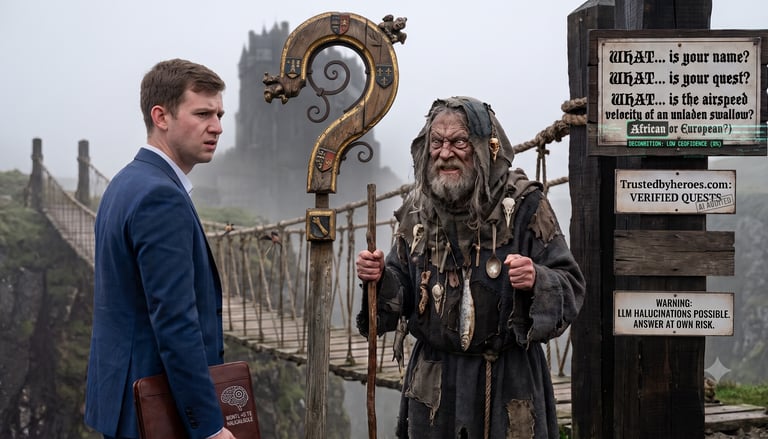
The Gorge of Eternal Peril Just Got an LLM Upgrade
Watching Monty Python and the Holy Grail recently, I couldn't help thinking the Bridgekeeper may have been the world's first poorly optimized AI compliance system.
Think about it. He's an automated gatekeeper running on rigid, hard-coded rules. Everything works perfectly—until a user presents an unexpected edge case. Then the entire system collapses.
Sound familiar?
Prompt Engineering Before Prompt Engineering
Most people approach AI the way Sir Robin or Sir Galahad approached the Bridge of Death. They panic, guess, change their answer halfway through, or confidently respond without enough information.
The result?
Immediate failure.
King Arthur takes a different approach.
When the Bridgekeeper asks the famous question:
"What is the air-speed velocity of an unladen swallow?"
Arthur doesn't hallucinate an answer.
He asks a better question.
"What do you mean? An African or European swallow?"
In a single sentence, Arthur exposes an undefined variable that the system never considered. He doesn't fight the prompt—he challenges its assumptions.
That's critical thinking.
Every AI Needs Exception Handling
The Bridgekeeper has absolute confidence... until reality asks for clarification.
His logic probably looked something like this:
if question_asked: if user_requests_clarification: raise SystemFailure
Moments later comes one of cinema's greatest error messages:
"Huh?... I... I don't know that!... Auuuuuuuugh!"
The 1975 equivalent of:
Internal Server Error (500)
The system didn't fail because the user was malicious.
It failed because the designer never anticipated a legitimate follow-up question.
The Real Hallucination
Today we spend a lot of time talking about AI hallucinations.
Sometimes, though, the bigger hallucination belongs to us.
We assume our systems are correct because they appear confident.
The Bridgekeeper wasn't lying.
He simply believed he possessed authority he hadn't actually earned.
His knowledge worked inside a very narrow domain—names, quests, favourite colours—but collapsed the moment someone tested the underlying assumptions.
That's a lesson every AI deployment team should remember.
What makes this important for you
Whether you're deploying AI inside a business, government department, hospital, law firm, or classroom, confidence is not competence.
A governance framework isn't there to slow innovation.
It's there to ask the "African or European?" questions before your customers do.
That's where critical thinking still beats automation.
Every.
Single.
Time.
The funniest scene in Monty Python and the Holy Grail may also be one of the best lessons in AI governance.
Before trusting an AI system to guard the Bridge of Death, make sure it actually knows the difference between an African and a European swallow.
Otherwise, it won't be your users falling into the Gorge of Eternal Peril.
It'll be your credibility.
Patent Pending • Human Reviewed under Distributed Human-in-the-Loop (DHITL) Governance • Good-Faith Review • 2026-07-19 UTC
Supporting
Getting Veterans and First Responders back on mission.!
Veteran-inspired AI Governance & Trust Infrastructure
Trusted by Heroes and Mounted Rifles Management
Leadership and peer support are taught through RedFridayTalks.Help
The same governance protections are available to everyone.
© 2026. All rights reserved.