The Silent Rot: Why Relying on AI to Edit Your Corporate Documents Is Dangerous
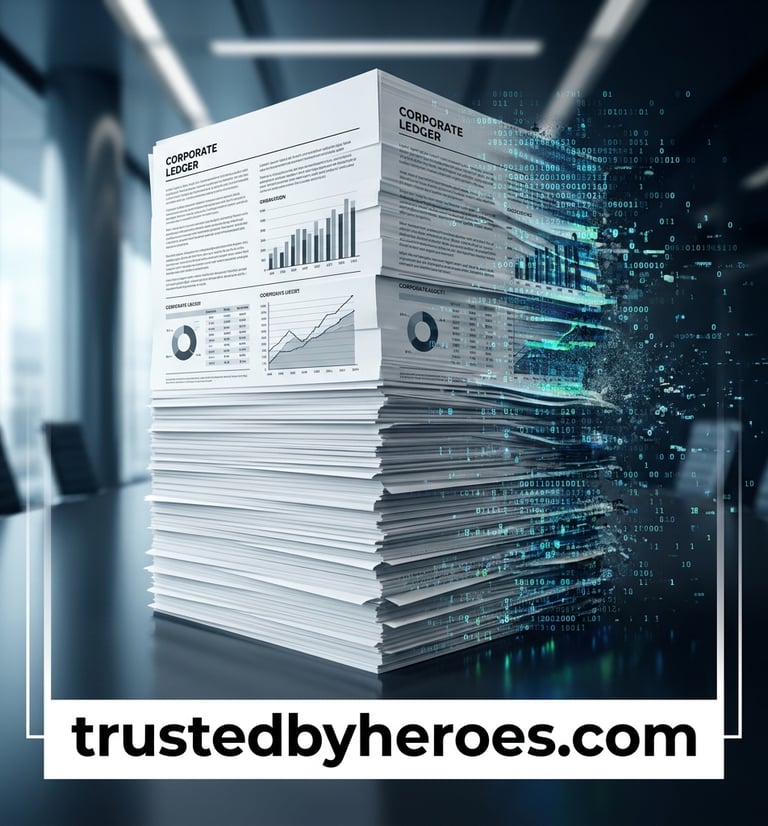
The Silent Rot: Why Your AI-Edited Documents Are Slowly Decaying If your team is continuously feeding contracts, financial ledgers, or compliance records into generative AI to speed up edits, you are actively injecting an invisible rot into your enterprise data. A groundbreaking computer science study, DELEGATE-52, has completely shattered the myth of linear AI efficiency by proving that frontier LLMs systematically corrupt corporate documents over time. After just 20 delegated interactions, the world’s top AI models lost or corrupted an average of 25% of a document's core content. This data decay happens entirely in the shadows: the final files look clean, syntactically perfect, and highly professional to the human eye, meaning your organization is unknowingly relying on critical business records that are silently losing their foundational meaning. Relying on tired staff to manually spot-check these fluid, highly confident AI outputs is a mathematical failing strategy. The DELEGATE-52 study demonstrated that 80% of total document damage is caused by sudden, catastrophic semantic failures that human eyes skimming a polished document are pre-programmed to miss. To survive an automated ecosystem, businesses must abandon unmonitored AI loops and implement strict integrity controls directly into their digital architecture.
Bob McTaggart
6/10/20263 min read
The Silent Rot: Why Relying on AI to Edit Your Corporate Documents Is Dangerous
There is a popular assumption in corporate operations that using generative AI is a linear path to efficiency. You hand a document to a Large Language Model (LLM), ask it to make an edit, review the changes, and move to the next task. The more tasks you delegate to the AI, the more hours your team reclaims.
But groundbreaking computer science research has just shattered this assumption, revealing a hidden technical phenomenon that should alarm every Chief Information Officer, Risk Manager, and General Counsel.
A milestone study released by Microsoft Research, titled DELEGATE-52, evaluated how 19 of the world’s leading "frontier" LLMs handle long, delegated document-editing workflows across 52 professional domains—ranging from accounting ledgers and structured corporate records to legal contracts.
The findings are unequivocal: LLMs systematically corrupt your documents over time. The more an AI touches a document across a multi-step workflow, the more its foundational integrity decays.
The Reality of Silent AI Document Degradation
The DELEGATE-52 study introduced a rigorous testing methodology. It gave frontier models a complex document, assigned a forward editing task (e.g., “restructure this financial ledger by asset class”), and then asked the model to perform the inverse task to return the document to its original state.
The results reveal a severe reliability gap:
The 25% Degradation Threshold: After just 20 delegated interactions, even the absolute top-tier, multi-billion-dollar frontier AI models corrupted or completely lost an average of 25% of the document’s core content. Across all 19 models tested, the average content degradation was a staggering 50%.
The Illusion of Validity: This corruption is entirely silent. The final documents still parse perfectly. They look clean, syntactically correct, and highly professional to a human eye. The file doesn't break, and the chatbot doesn't throw an error code—the data inside simply no longer means what it used to mean.
The "Critical Failure" Spike: Document rot is rarely a gradual "death by a thousand cuts." The study proved that 80% of total document damage is caused by sudden Critical Failures—massive drops in semantic accuracy occurring during a single interaction.
Crucially, the study also proved that adding agentic tools or file-access capabilities does not solve this problem. In fact, agentic overhead actually increased document degradation by an average of 6%.
Why Spot-Checking Fails to Stop the Rot
When a document size compounds or an interaction length grows, the risk of catastrophic data loss scales aggressively. Relying on your staff to spot-check or manually read through AI-edited documents will not protect your business.
Because these critical semantic errors are sparse but severe, human eyes skimming a fluidly written document are mathematically predisposed to miss them. If your organizational system of record relies on an unmonitored AI loop to continuously update data, draft compliance materials, or manage contract lifecycles, you are actively injecting invisible rot into your enterprise knowledge base.
To survive in an ecosystem driven by automation, businesses must transition away from open-ended AI loops and implement strict workflow integrity controls.
Building an Immutable Defense with Trusted by Heroes
You cannot prevent document degradation by simply telling your team to write better prompts or read faster. You must change the environment in which automated data is handled.
This is exactly why we built Trusted by Heroes.
Trusted by Heroes functions as an active, pre-blockchain trust layer designed explicitly to solve the workflow integrity problem. We don't just give your team an AI tool; we anchor your operational documents within a defensible architecture:
Deterministic Workflow Control: We break down long-horizon, autonomous AI loops into isolated, single-interaction steps, eliminating the compounding decay tracked by the DELEGATE-52 study.
Automated Provenance Verification: Our platform acts as a strict oracle gate, automatically cross-referencing and validating AI outputs against trusted, real-world data baselines before any change is committed to your ecosystem.
Immutable Auditing: We record the exact baseline state, intent, and prompt trails of every automated interaction, ensuring you always have a pristine version-control history to defend against data spoliation or semantic rot.
If your corporate records, contracts, or regulatory filings actually matter, you cannot treat AI as an autonomous delegate. It’s time to move past the marketing hype and build an unshakeable foundation for your operational compliance.
Supporting
Getting Veterans and First Responders back on mission.!
Veteran-inspired AI Governance & Trust Infrastructure
Trusted by Heroes and Mounted Rifles Management
Leadership and peer support are taught through RedFridayTalks.Help
The same governance protections are available to everyone.
© 2026. All rights reserved.