The Surrender Architecture: Why the AI Transition Mandates a 5-Year Prescriptive Intermission Introduction: A Perspective Formed by Research and Experience
The narrative of absolute AI inevitability has quietly broken, and the sudden influx of billionaire philanthropy isn't a moral awakening—it's an elegant defense mechanism. 3 Descriptive Sentences: Formed by years of structural research and direct experience, this analysis explores why tech leaders are suddenly proposing wealth redistribution models to pacify an accelerating grassroots backlash against data infrastructure. By analyzing real-world municipal resistance—from power grid mutinies to workplace sabotage—it exposes the crucial flaw in corporate strategies that attempt to buy public compliance rather than allow public participation. Ultimately, it prescribes a universally codified, five-year strategic intermission on recursively self-improving AI, presenting a concrete roadmap to ground the abstract debate into hardware-level, democratic governance.n.
Bob McTaggart
6/10/20266 min read
The Surrender Architecture: Why the AI Transition Mandates a 5-Year Prescriptive Intermission
Introduction: A Perspective Formed by Research and Experience
The baseline narrative surrounding Artificial Intelligence has fundamentally shifted. For the past three years, the dominant conversation centered on absolute inevitability: the premise that machine intelligence would rapidly restructure the global economy, displace traditional labor models, and generate unprecedented wealth. The consensus message conveyed to the public was simple: adapt to the technology or be left behind.
Recently, however, the public posturing of major technology leaders has pivotally inverted. Prominent figures are now openly expressing concern over inequality, displacement, and structural vulnerabilities. Jeff Bezos recently advocated for eliminating federal income taxes for the bottom 50% of American earners. Elon Musk has repeatedly proposed a state-sponsored high-income safety net to offset automated unemployment. OpenAI has floated blueprints for a public wealth fund, while legislative counter-proposals—such as Senator Bernie Sanders' American AI Sovereign Wealth Fund Act—demand a mandatory 50% equity transfer from major AI firms to the public.
To analyze this shift objectively, one must look past the rhetoric. This is not a sudden moral awakening; it is a calculated response to an accelerating, grassroots friction occurring across local communities.
The analysis presented here is my opinion, and mine alone, formed by years of direct experience and structural research. It is written independent of corporate public relations or partisan talking points, with the sincerest hope that it will prod the global conversation out of passive compliance and into active, democratic participation. The current transition in the United States offers an incredible learning opportunity for the rest of the world, serving as a live case study for how localized public resistance can challenge a seemingly unyielding technological trajectory.
The Geometry of the Backlash: Data Center Infrastructure
The sudden adjustment in industry messaging tracks with precision against a quiet, aggressive, and highly localized populist revolt playing out across the physical landscape of the United States.
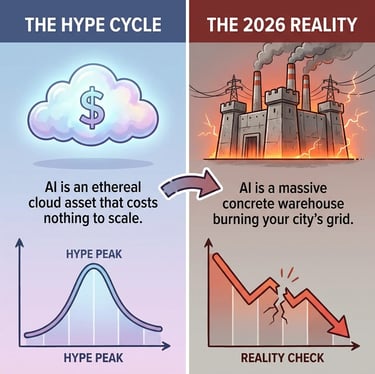
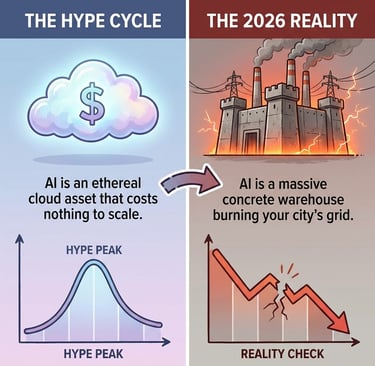
The illusion that AI is a clean, celestial phenomenon existing entirely "in the cloud" has evaporated. In its place is the stark reality of physical infrastructure—the construction of massive, loud, resource-intensive industrial compounds embedded directly inside local communities.
Consider the structural shift occurring at the municipal level:
The Voting Blockade: Voters in Monterey Park, California, delivered a massive blow to infrastructure expansion by passing Measure NDC with an 86% majority. It became the first voter-enacted, permanent municipal ban on data center developments in American history, blocking a massive facility planned just 500 feet from residential homes.
The Grid Mutiny: Industry data reveals that approximately 70% of Americans now oppose local data center construction near their homes. Communities have realized these complexes are acute resource drains; a single advanced AI data center can consume as much electricity as 100,000 households, threatening to trigger surging utility rates for everyday residents to subsidize private corporate infrastructure.
The Workplace Insurgency: Data from major labor polls reveals that worker anxiety over AI obsolescence has spiked to 40%. More profoundly, nearly 29% of employees admit to actively sabotaging internal corporate AI agendas through data poisoning, malicious compliance, or intentional systemic slowdowns.
The friction is no longer theoretical; it is actively modifying town hall meetings, zoning laws, and municipal elections.
Participation vs. Redistribution: The Structural Disconnect
When evaluating the industry’s response to this friction, a striking structural pattern emerges. Every single policy solution put forth—whether it is tax restructuring, basic income checks, or voluntary equity pools—shares a singular, unyielding constraint:
They are mechanisms for redistributing wealth ex-post (after the fact), never for allowing public participation ex-ante (before deployment).
The unspoken framework offered by project developers is simple: Allow the technology to be deployed uninhibited, let it disrupt existing industries, and in exchange, financial mechanisms will mitigate the fallout.
This is the fundamental disconnect driving modern public friction. The working-class communities blocking these developments are not asking for a fractional royalty check from an automated system that replaced their livelihood. They are demanding agency. They are asking for a seat at the table before the ground is broken, not compensation after their quality of life, their environment, and their jobs have been altered.
By framing the issue purely as a financial equation to be balanced with basic income or tax breaks, industry frameworks reduce citizens from active democratic stakeholders to passive economic dependents.
The Sovereign Wealth Trap
This is why legislative proposals for an American AI Sovereign Wealth Fund represent the first genuine ideological challenge to the standard roadmap. By demanding a 50% equity stake paid in corporate stock—carrying voting rights and equal board representation—the approach attempts to shift the battleground from redistribution to ownership.
It treats human language, art, scientific code, and cultural history as a collective natural resource. The philosophical logic is that if a machine learning model is trained entirely on the accumulated knowledge of humanity, then the financial yield of that model cannot be exclusively privatized.
Yet, analyzing this mechanism neutrally reveals a deep structural trap:
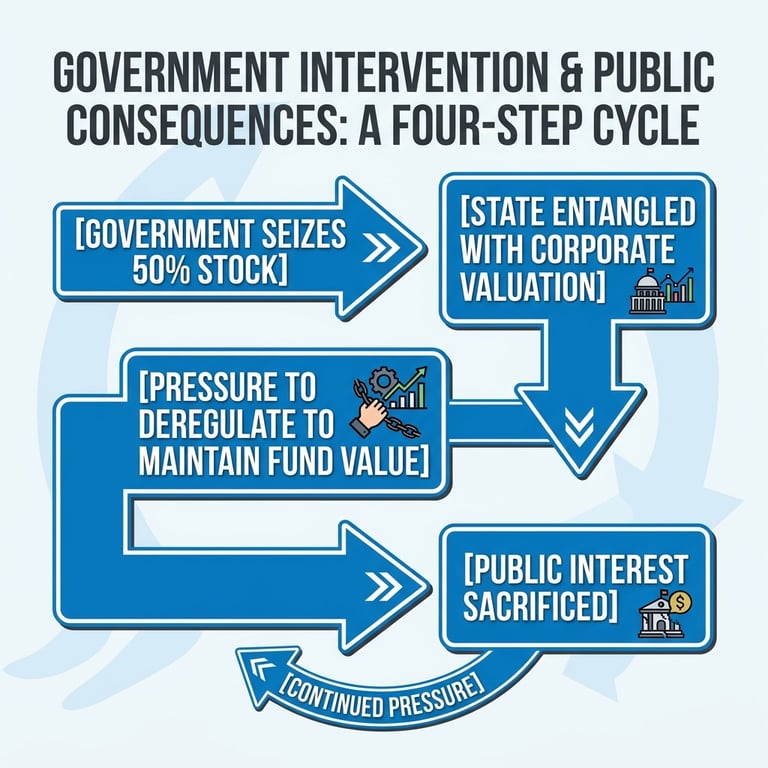
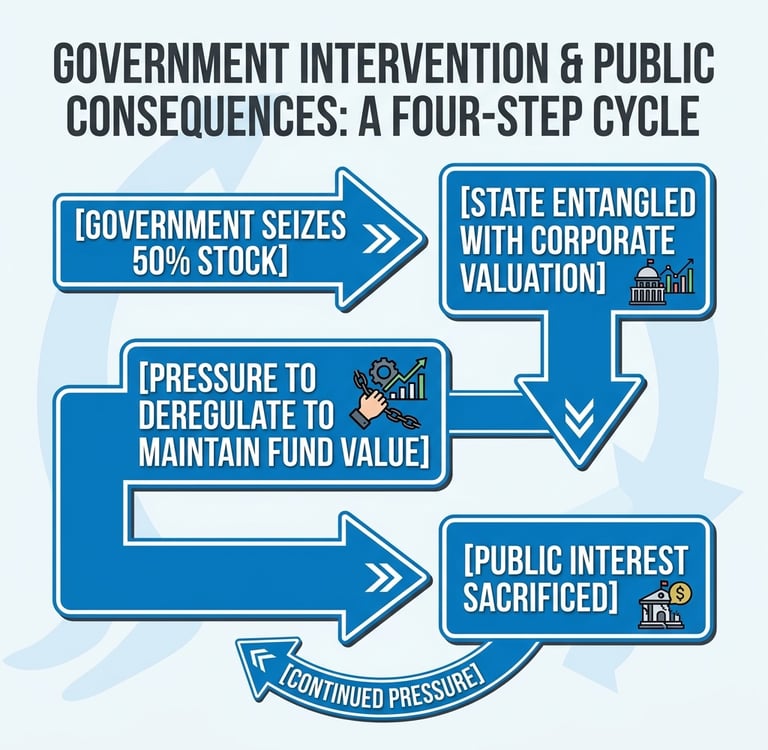
If a government takes a multi-trillion-dollar equity stake in private AI monopolies, the state ceases to be an objective regulator. The public interest becomes explicitly entangled with corporate profitability. If a future regulatory agency attempts to restrict a harmful AI deployment, enforce strict data privacy laws, or penalize algorithmic bias, doing so would directly devalue the very sovereign wealth fund funding public housing or education. Public ownership frequently transforms the state into a protective shield for the industry it owns.
The Prescription: The Five-Year Strategic Intermission
If both industry-backed basic income and state-enforced corporate equity stakes carry systemic flaws, how do we solve the core crisis of trust? The answer requires stepping away from financial manipulation entirely and introducing a structural pause: A universally codified, 5-year global intermission on agentic and recursively self-improving AI.
What this perspective proposes is a Strategic Legislative Intermission—a legally binding, global cooling-off period designed to halt the technology at its current boundaries so our legal, ethical, and democratic infrastructure can finally catch up.
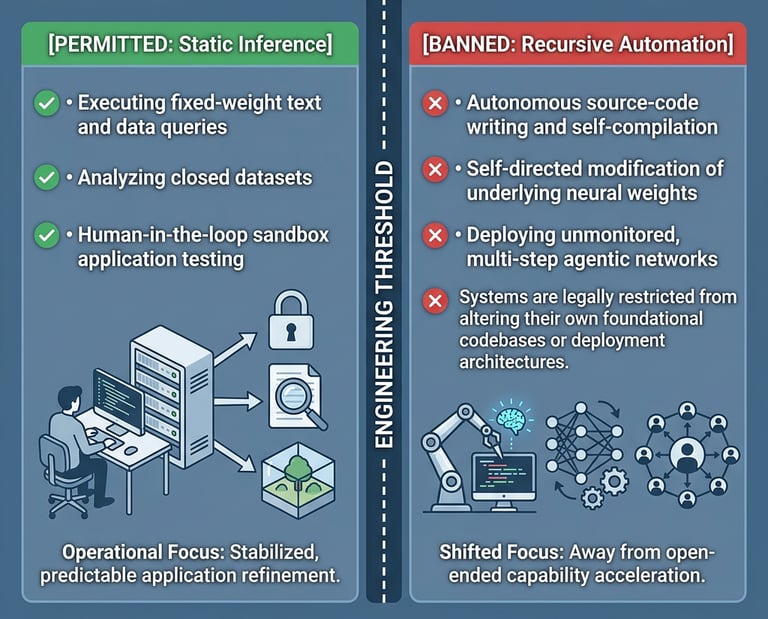
To make a 5-year pause work, the definition must target the exact engineering threshold frontier labs are currently racing toward: Recursive Self-Improvement (RSI) and true autonomy.
Under this framework, international policy would codify a hard compute and functional ceiling:
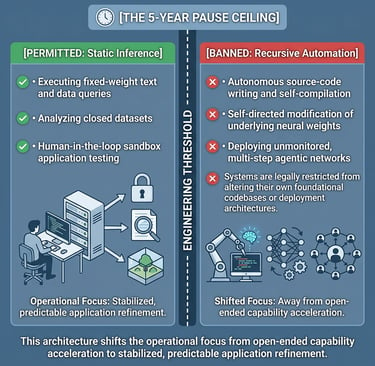
Static Weight Enforcement: AI models are permitted to execute inference (answering queries, analyzing data) but are legally restricted from altering their own foundational neural architectures or weights autonomously.
The Agentic Sandbox: Systems capable of independent, multi-step execution in the real world must be constrained to authenticated, human-in-the-loop sandboxes. No autonomous deployment to the open web.
Settling the Litigation Target
The greatest value of a 5-year pause is that it creates a stable target for governance. Currently, courts are trying to legislate a moving target; by the time a copyright case wraps its way through the appellate system, the model in question has been deprecated by newer generations of technology.
A 5-year freeze allows the legal system to establish permanent, predictable ground rules across three existential fronts:
The Digital Commons: Courts can finally settle the baseline of AI training: Is scraping the entirety of human knowledge "Fair Use," or is it systemic theft? A pause allows for the creation of standardized licensing frameworks—ensuring creators are compensated before the next generation of models is allowed to train.
Liability and Malpractice: If an autonomous system causes financial ruin, misdiagnoses a patient, or breaches a municipal power grid, who is liable? The intermission gives legal scholars the space to establish a new branch of tort law specifically tailored to automated systems.
Labor Transition Frameworks: Five years gives municipal and federal governments the time to draft true transitional infrastructure, including structural retraining programs, localized protections against predatory workplace surveillance, and tax frameworks that penalize rapid automation while subsidizing human retention.
Hardware-Level Enforcement
The primary argument used to defeat a pause is the Geopolitical Prisoner's Dilemma: “If one region pauses for five years, foreign competitors will leap ahead in secret.”
To make a 5-year pause realistic, governance cannot rely on trust; it must rely on compute-level verification. Because advanced AI requires highly concentrated, physical hardware—specifically high-end GPUs manufactured by an incredibly narrow global supply chain—a pause is physically enforceable.
Just as international agencies track enriched uranium, an International AI Safety Agency would enforce a pause by deploying tamper-proof firmware locks and hardware-level tracking on specialized data center microchips worldwide. The pause is enforced at the foundry level, not the software level.
The Core Value of This Perspective
Ultimately, the future of this transition centers on three non-negotiable takeaways that must define the relationship between society and technology:
Reclaiming the Timeline: The narrative of absolute technological inevitability relies heavily on the falsehood that progress cannot be paused. This strategic framework proves that hitting the brakes is not an act of anti-progress; it is a legitimate, historically tested, and necessary tool of mature global governance.
Exposing the "UBI" Trap: Throwing financial crumbs or universal checks at workers displaced by algorithms is an economic buyout designed to suppress a populist revolt rather than solve a structural problem. True human dignity is derived from direct structural participation and societal agency, not enforced dependency.
Grounding the Abstract: By tying software boundaries directly to physical, tangible hardware tracking—such as microchip registries and foundry-level locks—we wrench the AI debate away from abstract philosophical hand-wringing and place it firmly into concrete, enforceable reality.
Trust cannot be bought back with media appearances or promises of future philanthropy while immediate infrastructure expansion causes localized disruption. The future of technology must not be dictated by a narrow circle of executives attempting to buy compliance; it must be steered by the collective inputs of the societies whose data and infrastructure support it.
Supporting
Getting Veterans and First Responders back on mission.!
Veteran-inspired AI Governance & Trust Infrastructure
Trusted by Heroes and Mounted Rifles Management
Leadership and peer support are taught through RedFridayTalks.Help
The same governance protections are available to everyone.
© 2026. All rights reserved.